
Engineering Brief: When executing commercial facades or luxury residential projects, the choice of metal dictates the lifespan of the entire building envelope. A critical debate among architects is 6063-T6 aluminium vs standard grade aluminium. While local fabricators push “commercial grade” to cut costs, the technical reality is that non-tempered aluminium warps, oxidizes, and fails under wind load within just five years. Here is the engineering truth behind structural metal selection.
(Related: If you are upgrading interior spaces, review our recent breakdown on Acoustic Glass Partitions in Gurgaon.)
Technical Breakdown: 6063-T6 Aluminium vs Standard Grade
To truly understand the difference between 6063-T6 aluminium vs standard grade, we must look deeply into the metallurgical process. The numbers “6063” refer to the architectural alloy composition (primarily magnesium and silicon), but the most crucial part of the specification is the “-T6” suffix.
The “T6” designation means the metal has been solution heat-treated and artificially aged. During the T6 process, the extruded aluminium profile is heated to approximately 500°C, rapidly cooled (quenched), and then artificially aged in a specialized oven at 175°C for several hours. This controlled thermal tempering process aligns the molecular structure of the metal, dramatically increasing its tensile and yield strength. Standard commercial grade (often T4 or completely un-tempered scrap-mixed metal) skips this critical secondary hardening phase. It lacks structural integrity and remains dangerously soft for large-scale architectural applications.
Why the Best Aluminium Window Fabricators for Projects Insist on T6
When selecting the best aluminium window fabricators for projects, you must demand to see their extrusion certificates. BSIPL exclusively uses 6063-T6 because the hardened metal allows us to engineer slim-line profiles that can hold massive, heavy double-glazed units (DGU) without sagging over time.
Here is the exact engineering data explaining why standard grade fails on large elevations:
| Mechanical Property | 6063-T6 (BSIPL Standard) | Standard Commercial Grade |
|---|---|---|
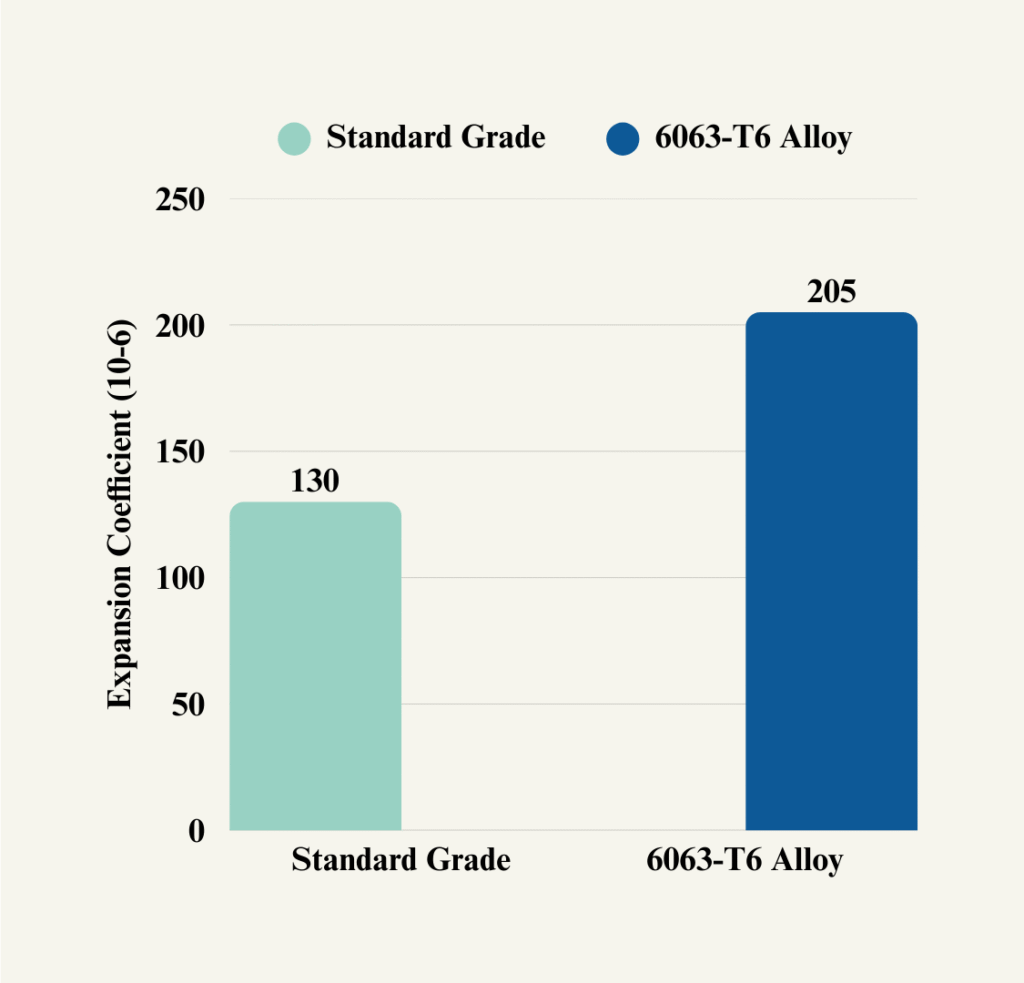
| Ultimate Tensile Strength | Min. 205 MPa (Highly Rigid) | ~130 MPa (Prone to bending) |
| Yield Strength | Min. 170 MPa | ~90 MPa |
| Wind Load Deflection | Minimal (Safe for high-rises) | High (Severe risk of glass cracking) |
The Hidden Impact on Hardware and Mechanism Longevity
Another major reason why top engineering firms refuse to use standard grade metal is the direct impact on hardware longevity. Premium sliding doors and casement windows rely on heavy-duty friction stays, multi-point locking systems, and stainless-steel rollers. When this hardware is screwed into soft, un-tempered standard grade aluminium, the internal threads strip easily over time.
The daily operational vibration causes hinges to loosen, leading to dropping sashes and misalignment. When analyzing 6063-T6 aluminium vs standard grade, the hardened T6 profile holds screws and mechanical cleats with incredible grip strength. This ensures that even massive floor-to-ceiling glass panels operate smoothly for decades without requiring constant emergency maintenance.
Creating Durable Aluminium Windows for Dusty Environments
In regions across North India, dust storms and extreme UV radiation are constant environmental threats. Standard grade aluminium often suffers from poor surface finishing because the softer metal does not hold powder coating effectively. This leads to rapid oxidation, pitting, and a chalky, faded appearance within just a few years.
Because of its hardened surface density, the T6 alloy bonds exceptionally well with premium AkzoNobel powder coatings and deep anodizing treatments. This creates highly durable aluminium windows for dusty environments. The hardened surface resists micro-scratches from wind-blown sand, ensuring the facade looks brand new for decades.
The Long-Term ROI Verdict
While local fabricators might offer a 10% to 15% upfront cost reduction by using non-tempered profiles, the long-term mathematical reality does not favor them. The choice between 6063-T6 aluminium vs standard grade is ultimately a choice between investing in a 50-year asset or purchasing a 5-year liability. When standard frames warp under wind pressure, the acoustic seals break, the air-conditioning leaks, and the glass risks shattering—costing you exponentially more in retrofitting and repairs.
Protect Your Next Commercial or Residential Project
Do not compromise your building envelope with weak, commercial-grade metal. Ensure total structural integrity with BSIPL’s certified T6 extrusion systems.
