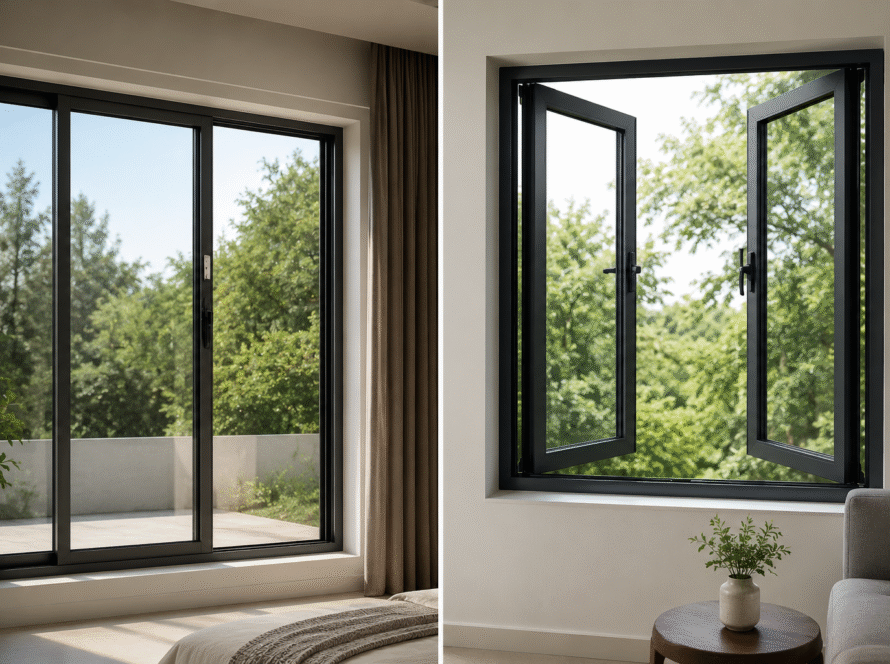
Thermal Break Aluminium Windows: How They Work & 7 Key Benefits
Aluminium windows are widely used in modern homes and commercial buildings because they offer strength, durability, slim profiles and design flexibility. However, aluminium is also a good conductor of heat. This means heat can travel relatively easily through a conventional aluminium window frame.
This is where thermal break aluminium windows can make a difference. A thermal break creates an insulating barrier between the inner and outer sections of an aluminium profile, helping reduce direct heat transfer through the frame.
For homeowners building premium homes, villas and modern architectural spaces, understanding how thermal break aluminium windows work can help when comparing different window systems.
In this guide, we explain what a thermal break is, how it works, the difference between thermally broken and conventional aluminium windows, and the key benefits you should consider before buying.
What Is a Thermal Break in Aluminium Windows?
A thermal break is an insulating barrier placed between the interior and exterior sections of an aluminium window profile. Instead of having one continuous aluminium path connecting the outside and inside surfaces, the thermal break separates the two sections.
This separation increases the resistance to heat transfer through the frame. In simple terms, the thermal break creates a less conductive path between the exterior and interior sides of the aluminium profile.
This is the basic principle behind thermal break aluminium windows. The aluminium still provides structural strength and design flexibility, while the thermal barrier helps improve the thermal performance of the frame.
However, it is important to understand that a thermal break does not completely stop heat transfer. It reduces direct heat transfer through the aluminium frame, while the overall performance of the window also depends on the glass, seals, hardware, fabrication and installation.
Why Does Aluminium Transfer Heat?
Aluminium has high thermal conductivity. This property makes aluminium useful in many engineering applications, but it also means that heat can travel efficiently through a conventional aluminium window frame.
During hot weather, the exterior side of a window frame can become significantly warmer due to sunlight and outdoor temperatures. Without a thermal barrier, some of this heat can transfer through the aluminium toward the interior side.
In colder conditions, the direction of heat transfer can be reversed, with indoor heat moving toward the colder exterior.
Reducing this direct thermal connection is one of the main purposes of thermal break aluminium windows.
How Do Thermal Break Aluminium Windows Work?
The working principle of thermal break aluminium windows is relatively simple. The aluminium profile is divided into separate interior and exterior sections, and an insulating material is placed between them.
The thermal barrier has much lower thermal conductivity than aluminium. As a result, it reduces the direct conductive path through which heat can travel across the frame.
The complete window can therefore provide better thermal separation between the outdoor and indoor environments compared with a conventional non-thermally broken aluminium profile.
The actual performance depends on the complete window system. The thermal break design, frame geometry, glass, gaskets, hardware and installation all contribute to the final result.
What Material Is Used for a Thermal Break?
Thermal breaks are generally manufactured using insulating polymer materials that can provide thermal separation while maintaining the required structural connection between the aluminium sections.
Polyamide is commonly used in many thermally broken aluminium window systems. It can provide a thermal barrier while allowing the aluminium profile to retain its structural and architectural advantages.
The exact material, width and construction of the thermal barrier can vary between different window systems and manufacturers.
Therefore, when comparing thermal break aluminium windows, it is better to ask for the actual system specifications rather than relying only on the term “thermal break.”
Thermal Break vs Non-Thermal Break Aluminium Windows
The key difference between the two systems is how the aluminium profile handles heat transfer between the exterior and interior sides.
| Feature | Non-Thermal Break Aluminium Window | Thermal Break Aluminium Window |
|---|---|---|
| Profile Construction | Continuous aluminium connection | Interior and exterior aluminium sections separated by an insulating barrier |
| Heat Transfer | Higher direct heat transfer through the frame | Reduced direct heat transfer through the frame |
| Thermal Performance | Generally lower frame insulation | Improved frame thermal insulation |
| Indoor Comfort | Frame temperature can be more influenced by outdoor conditions | Better thermal separation between indoor and outdoor conditions |
| Energy Performance | Depends on the complete window configuration | Can provide improved thermal performance when properly specified |
| Applications | Standard applications | High-performance residential and commercial applications |
7 Key Benefits of Thermal Break Aluminium Windows
The use of a thermal barrier can provide several benefits when the complete window system is properly designed and installed.
1. Reduced Heat Transfer Through the Frame
The primary purpose of a thermal break is to reduce direct heat transfer through the aluminium frame.
By separating the interior and exterior aluminium sections with an insulating barrier, thermal break aluminium windows can reduce the conductive heat path through the frame.
This can be particularly useful in buildings exposed to strong sunlight and high outdoor temperatures.
2. Improved Indoor Thermal Comfort
Windows are an important part of the building envelope. Their performance can influence how indoor spaces respond to outdoor temperatures.
Thermal break aluminium windows can help reduce the effect of outdoor temperature on the aluminium frame, contributing to better indoor thermal comfort when combined with suitable glazing, shading and building insulation.
The final level of comfort depends on the complete building design rather than the thermal break alone.
3. Improved Energy Performance
Reducing heat transfer through the frame can contribute to better overall thermal performance.
In air-conditioned buildings, reducing unwanted heat gain may help reduce the cooling load. However, actual energy savings depend on many factors, including the glass specification, building orientation, window area, shading, insulation and HVAC system.
For this reason, thermal break aluminium windows should be considered as one part of an overall energy-efficient building design.
4. Can Help Reduce Condensation Risk
Condensation occurs when a surface becomes sufficiently cold for moisture in the surrounding air to condense on it.
A thermal break reduces direct temperature transfer through the aluminium frame and can help keep the interior frame surface warmer under suitable conditions.
This can reduce the risk of condensation on the frame, although it does not guarantee condensation-free performance. Indoor humidity, ventilation, glass temperature and climate also play important roles.
5. Suitable for Large Glass Openings
Modern architecture increasingly uses large windows, floor-to-ceiling glazing and expansive sliding doors.
Large glass openings can increase the importance of thermal performance because windows represent a significant part of the building envelope.
Thermal break aluminium windows can provide a useful combination of aluminium’s structural properties and improved thermal separation for these applications.
6. Combines Aluminium Strength With Thermal Insulation
Aluminium is valued for its strength, durability and design flexibility. A thermal break system allows these properties to be retained while introducing an insulating barrier between the exterior and interior profile sections.
This makes thermally broken aluminium systems suitable for many contemporary residential and commercial designs.
7. Supports High-Performance Window Design
A high-performance window is not defined by a single component. The aluminium profile, thermal break, glass, gaskets, hardware, drainage, fabrication and installation all work together.
A properly engineered thermal break system can therefore be an important part of a high-performance aluminium window solution.
Are Thermal Break Aluminium Windows Suitable for India’s Climate?
India has a wide range of climatic conditions, from hot and dry regions to humid coastal areas and colder northern regions.
In areas with high summer temperatures, reducing heat transfer through window frames can be useful, particularly in buildings that rely heavily on air conditioning.
However, the correct window system should always be selected according to the specific location, climate, building orientation, glazing specification, shading strategy and project requirements.
For premium homes with large glass openings, combining thermal break aluminium windows with appropriate high-performance glazing can help create a more thermally efficient building envelope.
Do Thermal Break Windows Reduce Heat Inside the Home?
They can reduce heat transfer through the aluminium frame, but it is important to understand that the frame is only one part of the complete window.
The glass can account for a large percentage of the window area and can have a major influence on solar heat gain.
For example, a large window exposed to direct sunlight can still allow significant solar heat into a room if the glass is not appropriately selected, even when the aluminium frame has a thermal break.
Therefore, frame and glass should be selected together based on the building’s climate, orientation and performance requirements.
Thermal Break Windows and Glass: Why Both Matter
When evaluating thermal break aluminium windows, it is important not to focus only on the aluminium profile.
The glass occupies a large visible area of most modern windows and can significantly affect thermal performance, solar heat gain and indoor comfort.
Depending on the project, glass options may include:
- Double glazing
- Low-E glass
- Solar-control glass
- Laminated glass
- Toughened glass
- Insulating glass units
The correct glass depends on the project’s climate, orientation, safety requirements, comfort expectations and architectural design.
Can Thermal Break Windows Help With Noise Reduction?
A thermal break is primarily designed to reduce thermal transfer. It should not be treated as a dedicated soundproofing solution.
However, the acoustic performance of a complete window can be influenced by the frame, glass, gaskets, glazing configuration and installation.
If noise reduction is an important requirement, the glass and sealing system should be specifically selected for acoustic performance.
Therefore, thermal break aluminium windows can be part of a high-performance window system, but acoustic performance should be evaluated separately.
How to Identify Genuine Thermal Break Aluminium Windows
If a manufacturer describes a window as thermally broken, ask for specific information about the actual system construction.
Questions to ask your manufacturer:
- Does the profile contain a physical thermal barrier?
- What material is used for the thermal barrier?
- What is the thermal break configuration?
- What thermal performance data is available?
- What glass specification is recommended?
- Is technical documentation available?
- Has the complete window system been tested?
- What performance classifications apply to the system?
Do not select a window simply because the word “thermal” appears in a brochure. The actual system construction and technical performance are more important than marketing terminology.
What Should You Check Before Buying Thermal Break Aluminium Windows?
Before finalising thermal break aluminium windows, compare the complete specification rather than looking only at the frame or price.
- Aluminium profile system
- Thermal break construction
- Glass specification
- Hardware quality
- Gasket and sealing system
- Air permeability
- Water tightness
- Wind-load performance
- Thermal performance
- Fabrication quality
- Installation method
- Warranty
- After-sales support
Why Installation Matters
Even a well-designed thermal break system can underperform if it is incorrectly fabricated or installed.
Incorrect measurements, poor alignment, inadequate sealing and unsuitable fixing methods can negatively affect the performance of the complete window.
The connection between the window and the building structure should therefore be properly planned and executed.
Professional installation is an important part of getting the expected performance from thermal break aluminium windows.
If you want to understand why professional window installation matters, you can also read our article on professional aluminium window and door solutions from BSIPL.
Check Applicable Standards and Technical Information
When purchasing aluminium windows, it is useful to ask the manufacturer about applicable standards, system specifications and performance testing.
In India, IS 1948:2024 covers aluminium framed doors, windows and sliders. Buyers can refer to the official Bureau of Indian Standards (BIS) database to check information about applicable Indian Standards.
Depending on the system and application, relevant performance areas can include air permeability, water tightness, wind resistance, operating performance and other applicable requirements.
When evaluating thermal break aluminium windows, ask the manufacturer for applicable technical specifications, system details and test documentation where available.
Do Not Compare Thermal Break Windows Only on Price
Price is an important consideration, but comparing aluminium windows only by price per square foot can result in an incomplete comparison.
Two quotations may appear similar while offering different specifications for the aluminium profile, thermal barrier, glass, hardware, gaskets, finish, fabrication and installation.
Before comparing prices, make sure you are comparing equivalent specifications.
Your comparison checklist should include:
- Aluminium profile system
- Thermal break specification
- Glass type and thickness
- Hardware specifications
- Locking system
- Gasket type
- Surface finish
- Air and water performance
- Thermal performance
- Fabrication quality
- Installation method
- Warranty
- After-sales service
Frequently Asked Questions About Thermal Break Aluminium Windows
What is a thermal break in an aluminium window?
A thermal break is an insulating barrier placed between the interior and exterior sections of an aluminium window profile. It reduces the direct path for heat transfer through the frame.
Are thermal break aluminium windows better than regular aluminium windows?
Thermally broken systems can provide improved thermal performance compared with conventional non-thermally broken aluminium profiles. However, the complete performance depends on the glass, seals, hardware, fabrication and installation.
Do thermal break windows reduce electricity consumption?
They can contribute to improved energy performance by reducing heat transfer through the frame. Actual energy savings depend on the complete building design, glazing, orientation, shading, insulation and HVAC usage.
Are thermal break aluminium windows suitable for hot climates?
They can be useful in hot climates because reducing heat transfer through the frame can contribute to better indoor thermal comfort. The glass and shading strategy should also be selected according to the local climate.
What material is commonly used for a thermal break?
Polyamide is commonly used as a thermal barrier material in many thermally broken aluminium window systems. The exact material and system design can vary by manufacturer.
Can thermal break windows prevent condensation?
A thermal break can reduce the likelihood of condensation on the frame by reducing thermal transfer, but it cannot guarantee that condensation will never occur. Indoor humidity, ventilation, climate and glass temperature also influence condensation.
Final Thoughts
Thermal break aluminium windows are designed to combine the strength, durability and design flexibility of aluminium with improved thermal separation between the interior and exterior sections of the frame.
The basic principle is simple: an insulating barrier reduces the direct conductive path through which heat can travel across the aluminium profile.
However, the thermal break is only one component of a high-performance window. Glass, gaskets, hardware, air tightness, water tightness, fabrication and installation all contribute to the final result.
If you are planning a premium home, villa or architectural project with large glass openings, understanding thermal break aluminium windows can help you make a more informed decision when comparing different window systems.
Choosing the right system means looking beyond the appearance and comparing the actual technical specifications, performance requirements and installation quality.
BSIPL provides premium aluminium doors and windows with a focus on precision, performance and long-term reliability. Before selecting a window system, compare the complete specifications and choose a solution appropriate for your project’s climate, design and performance requirements.
Explore premium aluminium doors and windows on the BSIPL website.