
“`html
When engineering a facade for the Delhi NCR skyline, Wind Load Calculation for High Rise Buildings is the most critical safety metric. Unlike low-rise residential units, skyscrapers in Gurgaon Phase 5 or Noida Expressway act as massive sails, catching high-velocity winds that create immense inward and outward pressure. Building on our analysis of powder coating vs anodizing for aluminium, we now address the ultimate physics behind facade stability.
As cities continue to build taller commercial towers and mixed-use developments, facade systems must withstand increasingly demanding environmental conditions. Wind pressure is one of the most important design considerations because it directly impacts structural safety, glazing performance, weather resistance, and long-term durability.
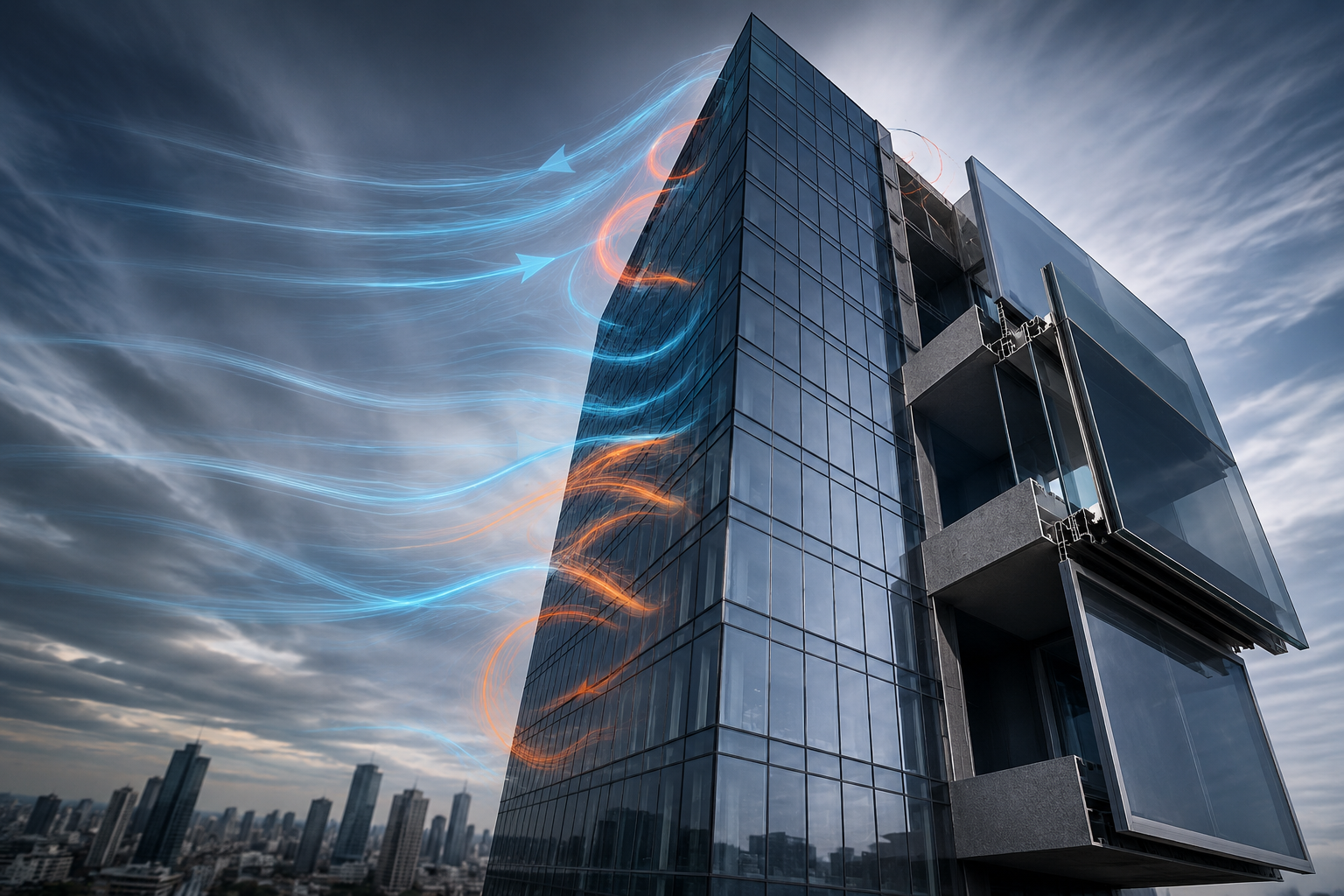
The Proven Importance of 2.5 kPa Engineering
In the architectural world, Wind Load Calculation for High Rise Buildings follows the IS 875 (Part 3) standard. For a 20th-floor office in Sector 62, Noida, the wind doesn’t just push; it “sucks” the glass outward through negative pressure. If a fabricator uses retail-grade profiles (1.2mm to 1.5mm), the frame can bow or “flutter,” leading to a catastrophic failure of the sealant bond.
At BSIPL, our superior engineering standard mandates a 2.5 kPa (KiloPascal) resistance for all high-rise installations. We utilize 6063-T6 Grade Aluminium with a minimum 2.0mm to 2.5mm wall thickness. This essential rigidity ensures that the structural members can withstand gusts of over 150 km/h without compromising the integrity of the building envelope.
Accurate engineering calculations not only protect occupants but also reduce maintenance issues over the lifespan of the building. A properly engineered facade performs more reliably under extreme weather conditions while maintaining air-tightness and water-tightness.
3 Factors That Influence Wind Load Calculation
When drafting a Bill of Quantities (BOQ) for high-ticket projects, Procurement Managers must understand these three proven variables:
- Terrain Category: Buildings near the open plains of the Yamuna Expressway face higher wind speeds than those shielded in the Delhi Ridge area.
- Building Shape: Aerodynamic vortex shedding can significantly increase stress on corner glass panels.
- Opening Ratio: Even a small gap in an incorrectly installed gasket can lead to internal pressure failure.
Another important aspect of Wind Load Calculation for High Rise Buildings is facade orientation. Buildings with large glass elevations facing prevailing wind directions often experience higher pressure concentrations. Engineers must carefully evaluate site conditions before finalizing profile thickness, reinforcement requirements, and glazing specifications.
Modern commercial towers are increasingly designed with large glass surfaces to maximize daylight and create premium architectural aesthetics. While visually impressive, these systems require advanced structural analysis to ensure long-term safety and performance.
Comparison: Retail Windows vs. BSIPL High-Rise Engineering
| Technical Feature | Standard Retail Windows | BSIPL Engineered Facades |
|---|---|---|
| Max Wind Pressure | 0.8 kPa – 1.2 kPa | 2.5 kPa – 3.5 kPa (Proven) |
| Profile Alloy | Commercial 6063 | 6063-T6 Structural Grade |
| Sealant Type | Weather Silicone | Dow Corning 995 Structural |
| Gasket Material | PVC/Rubber | EPDM (High-Elasticity) |
The Role of EPDM and Dow Corning in Wind Resistance
A successful Wind Load Calculation for High Rise Buildings is useless if the secondary components fail. Under high wind pressure, the glass “floats” within the frame. We exclusively use Dow Corning 995 Structural Sealant, the best-in-class adhesive for high-stress environments.
This sealant, paired with EPDM gaskets, allows the glass to move slightly under wind load without breaking the air-tight seal. The combination improves weather resistance, prevents water infiltration, and increases the overall lifespan of the facade system.
In locations like Gurgaon’s Golf Course Extension Road, where high-rises are exposed to unblocked winds, this ultimate combination of materials prevents whistling noises and water seepage during monsoon storms.
This critical attention to detail is why BSIPL remains a preferred choice for Project Management Consultants (PMCs), architects, and developers working on large-scale commercial projects.
Why High-Rise Facade Engineering Requires Specialized Expertise
High-rise buildings require a completely different engineering approach compared to standard residential structures. Wind pressure increases significantly with height, requiring stronger structural members, specialized glazing systems, and advanced weather-sealing technologies.
Professional facade engineering not only improves structural safety but also enhances thermal performance, occupant comfort, acoustic insulation, and long-term maintenance efficiency. This comprehensive approach reduces risk and ensures that buildings continue to perform as designed for decades.
Conclusion: Engineering Success Above the 10th Floor
Accurate Wind Load Calculation for High Rise Buildings is the difference between a lifelong asset and a dangerous liability. By choosing superior 6063-T6 profiles and industrial-grade sealants, BSIPL ensures that your commercial tower in Noida or South Delhi stands resilient against the elements.
Our technical team provides site-specific wind simulations, engineering support, and BOQ recommendations to ensure every project achieves the highest standards of safety, performance, and long-term durability.
“`
